


 ‘Tis the season for leftover corned beef. One of my favorite ways to enjoy it is a nice, fat corned beef on rye, spread thickly with mustard. This rye bread is easy and oh-so-tasty to whip up at home.
There are a zillion recipes for homemade rye bread. This is how I make mine.  It’s part rye flour and part regular, all-purpose flour. The mix produces a light, airy loaf with a moist crumb and soft, chewy crust.
  This recipe makes enough for two good-sized loaves of bread. I tend to make mine free-form, but you can certainly mold your dough into any shape you like. You’ll just have to monkey around with the baking time.
  For the flour, I used Hodgson Mill old-fashioned, stone-ground rye flour.
 Many rye bread recipes call for brown sugar or molasses. I used molasses.
  It gives the bread a slightly darker color and a more complex flavor, without adding any real sweetness.
  I used my stand mixer to knead the dough, but you can certainly make it the old-fashioned way: By hand, with a lot of elbow grease.
Soft and Chewy Rye Bread
2 cups lukewarm water 1/4 cup unsulphured molasses 1 Tbls. yeast 2 Tbls. olive oil 1 cup rye flour 1 Tbls. kosher salt 4 1/2 cups unbleached, all-purpose flour 2 Tbls. caraway seeds Yields 2 large loaves
Soft and Chewy Rye Bread: Make the dough
Put the warm water in the bowl of your stand mixer. It should be lukewarm, not hot. (If it’s too hot, it can kill your yeast…leaving you with dough that doesn’t rise.)  Add the molasses to the water.
  Whisk to combine well.
  Add the yeast to the molasses water.
 Whisk again to combine. Let the mixture sit for about 5 minutes to give the yeast time to bloom.
  Wait, bloom? Yep, bloom. Don’t skip this step, unless you’re sure that your yeast is fresh. (It’d be a shame to go through the trouble and ingredients to make the bread, only to realize that your yeast is dead.) The warm water wakes the yeast up, and the sugar in the molasses gives it a little snack to get it working. After about 5 minutes, if your yeast is happy and alive, you’ll see a little raft start to form on the surface of the mixture, like this:
  Next, drizzle in the olive oil.
  Add the rye flour and the kosher salt.
  Whisk to combine well.
  Next, add the all-purpose flour.
  Switch from a whisk to a wooden spoon and stir to combine.
  Toss in the caraway seeds.
Soft and Chewy Rye Bread: Knead the dough
Once you’ve added the caraway seeds, fit the bowl onto your stand mixer. Attach the dough hook and knead on medium for about 5 minutes.  The dough will come together in a sticky ball.
  After about 5 minutes, the dough will still be fairly sticky. That’s just fine. (Don’t add more flour…you’ll make it too dense.)
Soft and Chewy Rye Bread: The first rise
Round the dough up into a neat ball in the bottom of your mixing bowl. 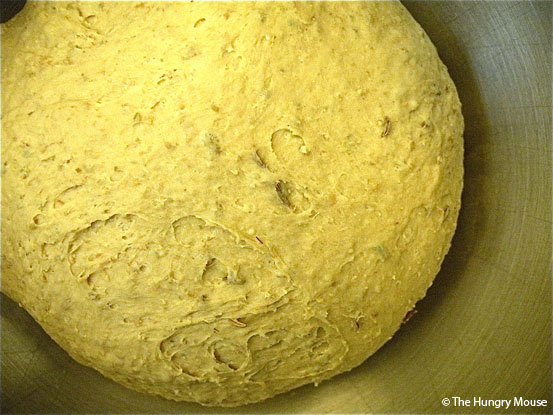
 Cover the bowl with a damp cloth or a damp few paper towels. Set it in a warm place to rise for an hour, or until it’s about doubled in size.
Soft and Chewy Rye Bread: Form the loaves & let rise again
Line a sheet pan with parchment paper or a silicone baking mat. After about an hour, your dough should have about doubled in size, like this:  Smoosh all the air out of it with your hands. Form it into a nice, tight ball and set it on a board. At this point, it shouldn’t really stick, but if it does, toss a little flour under it.
  With a bencher or sharp knife, divide the dough in half.
  Knead each ball a few times.
  Form each ball into an oblong, kind of football shape. Set the loaves a fair distance apart on your prepared pan, like this:
 Cover the loaves with a damp cloth or damp paper towels. Set the pan in a warm place.
  Let them rise again for about an hour, until they’ve about doubled in size, like this:
Soft and Chewy Rye Bread: Bake the bread
Remove the towel. If you like, cut a few shallow slashes in the top of each loaf with a very sharp knife.  Cut with your knife on an angle like this. You want to be very careful not to poke the loaf too much, and deflate it.
  When the bread bakes, the slashes will open up and create a very nice looking loaf.
  Slide the pan into the oven. (Wait! A cold oven?? Yes, a cold oven.) Set the temperature to 400 degrees and bake like this for 15 minutes. After 15 minutes, lower the temp to 350 degrees. Bake at 350 for 20-25 minutes more.
Soft and Chewy Rye Bread: How can I tell when the bread is baked?
Pick up one of the loaves with a pot holder-clad hand. Flip it over, so the bottom is facing you. It should be nice and brown. With your other hand, give the middle of the bottom of the loaf a thump. It should sound hollow. If it sounds dull, it likely needs a few more minutes in the oven. 
Soft and Chewy Rye Bread: Cool, serve, and enjoy!
When your bread is done, slide the loaves on to a rack to cool completely.  When the bread is cool, slice and enjoy!


